The Quiet Fear Behind Every Delayed Modernization Decision
Modernization projects carry one quiet fear that rarely makes it into a steering committee slide. That fixing operations means disrupting the operations you are trying to fix. It is a reasonable fear, and it is usually the real reason a needed upgrade gets delayed another year, even when everyone involved agrees the current system is holding the business back.
A poorly sequenced ERP rollout can pull attention away from production at exactly the moment attention is needed elsewhere. It can slow store operations mid season, when every hour of checkout downtime has a direct revenue cost. It can force a team to run two processes at once for months, duplicating work instead of reducing it, which is precisely the opposite of what the modernization was supposed to achieve.
The gap is rarely where it first appears. Most operations leaders who take the ERP Fit Quiz find the real friction point is one layer deeper than where they have been looking.
See Where Your Operations Actually Stand — 2 Minutes
→ Speak with Our Team
This fear is not a failure of nerve on the part of operations leadership. It reflects an accurate read of how modernization projects often go wrong. The technology usually works as advertised in a controlled environment. What breaks is the transition period, when the old and new systems have to coexist, and the business cannot afford to pause while that coexistence gets sorted out.
Systems that need modernization today typically need it more urgently a year from now, because the gap between what the business needs and what the current system supports widens with time rather than closing on its own.
Why Modernization Delays Compound Instead of Resolving Themselves
The instinct to delay a needed upgrade until the risk feels more manageable is understandable, but it rarely produces a lower risk transition later. Systems that need modernization today typically need it more urgently a year from now, because the gap between what the business needs and what the current system supports widens with time, not shrinks.
Meanwhile, the fear itself becomes a kind of tax on the business. Workarounds accumulate around the current system’s limitations. Staff build informal processes to compensate for gaps the software was never going to close on its own. By the time modernization finally happens, there are more workarounds to account for, which makes the transition itself more complex than it would have been a year earlier.
How SuperBotics Builds Modernization Around Business Continuity
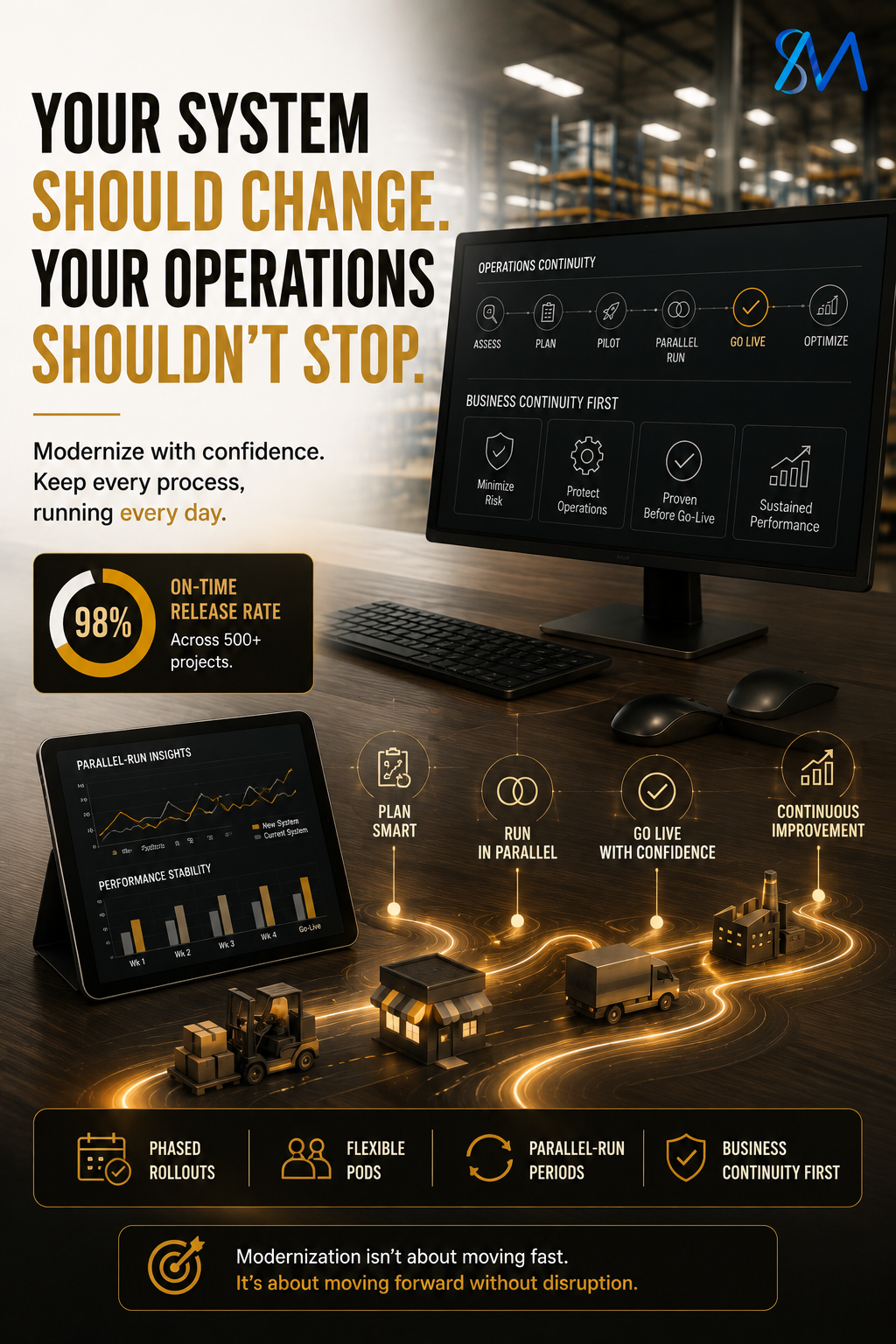
Across 500+ projects, we build modernization plans around exactly this constraint: business continuity first, technology second. That ordering shapes every decision in the engagement, not just the cutover date.
Phased rollouts break the modernization into stages small enough that any single stage failing does not threaten the whole operation. Parallel-run periods let the new system prove itself against the old one under real production conditions before the old system is switched off. And pods that scale up or down within two weeks mean the team investigating an unexpected issue during rollout is never stuck waiting for additional resourcing to be approved.
Nothing goes live until it has proven itself alongside the system it is replacing. That single principle, applied consistently, is what allows modernization to happen without the disruption operations leaders are right to fear.
How a Continuity-First Modernization Plan Differs From a Feature-First One
- Rollout stages are sized around what the business can absorb, not around project milestones
- Parallel-run periods are treated as mandatory validation, not optional extra testing
- Rollback plans exist before cutover begins, not as an improvised response if something breaks
- Pod capacity scales to match what the rollout surfaces, rather than being fixed in advance
What This Approach Has Delivered Across Enterprise Engagements
With a 98% on-time release rate across 150+ enterprise launches, this approach to modernization has been tested across manufacturing, retail, and operations environments where the cost of disruption is measured in lost production hours or missed shipment windows. The companies modernizing successfully are not the ones moving fastest. They are the ones who never let the transition become the disruption they were trying to avoid.
That distinction matters because speed and safety are often framed as trade-offs in modernization projects. In practice, the organisations that move deliberately through a properly sequenced rollout tend to reach full modernization faster than the ones who rush a big-bang cutover, get burned, and spend months recovering before they can even resume the original project.
What SuperBotics Delivers for ERP and Operational Modernization
We deliver ERP and operational modernization built for business continuity first, across SAP, Dynamics, Odoo, Salesforce, and Zoho, with a 98% on-time release rate. That includes the phased rollout planning, the parallel-run validation, and the pod capacity to respond to what the rollout actually surfaces, rather than what a project plan assumed it would surface six months earlier.
What a Rushed Rollout Costs Beyond the Obvious Downtime
The visible cost of a rushed modernization is the outage everyone notices immediately, a checkout system down for an afternoon or a production line paused for a shift. The less visible cost shows up weeks later, in the form of data that migrated incorrectly but did not fail loudly enough to be caught during cutover weekend. Inventory counts that drift because a mapping rule handled one product category correctly and silently mishandled another. Financial postings that reconcile in aggregate but hide individual errors that only surface at month end close.
This is why parallel-run validation has to run long enough to catch slow-surfacing errors, not just the ones that break something immediately. A validation window measured in days catches obvious failures. A validation window measured across a full business cycle, including month end and any seasonal peak relevant to the business, catches the errors that would otherwise take months to notice and far longer to unwind.
The clearest starting point we have seen: know what your operations are actually ready for before deciding what to change.
The ERP Fit Quiz surfaces that picture honestly — no interpretation required.
Planning the Transition Before It Becomes Urgent
One question changes how most operations leaders see this decision: where does your operation actually stand right now, separate from how urgent the modernization feels? The companies that modernize without disruption are not the ones with the least at stake. They are the ones who planned the transition before they needed it, rather than after the current system’s limitations became too expensive to ignore any longer.
Leave a Reply