There is a specific moment every controller recognises. The books are supposedly closed, the deck is nearly ready for the board, and one number does not feel quite right. Not wrong exactly, just off by enough to notice. What happens next is almost always the same. Someone opens a spreadsheet, quietly rebuilds the number by hand, and does not mention it to anyone unless the gap turns out to be large enough to matter.
Nobody schedules that hour. It simply happens, every close, to whoever notices the discrepancy first. Multiply that hour across every close cycle in a year, across every finance team member absorbing a version of the same gap, and the cost stops being a rounding error. It becomes a recurring tax on a process that most organisations have quietly accepted as normal because nobody has ever stopped to ask why a close that should take one day is taking four.
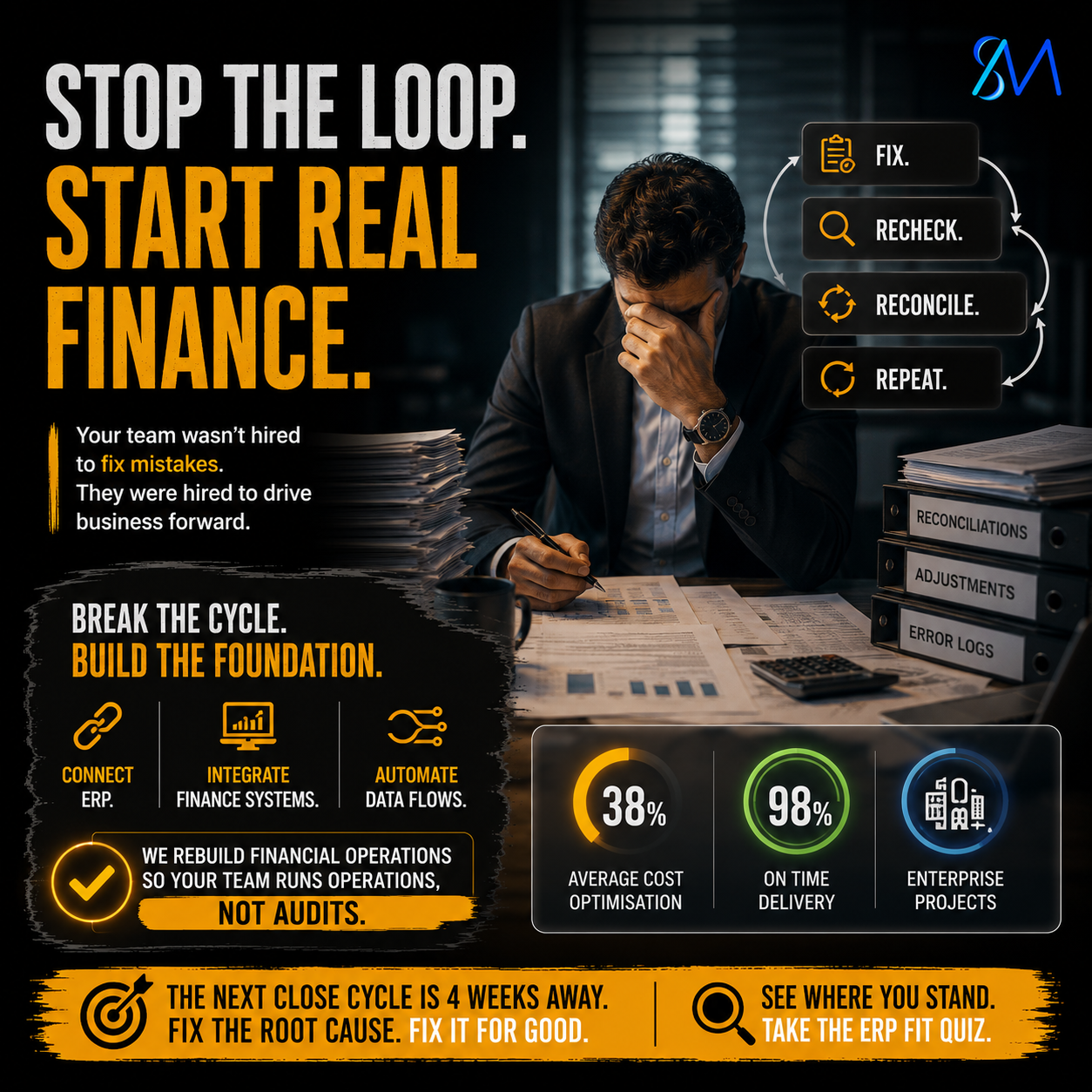
Across the 500+ enterprise engagements we have delivered, financial close reconciliation is one of the clearest examples of a manual layer masquerading as a process. Finance teams did not build their careers to run fix, recheck, reconcile, repeat cycles every month. They run them because the systems underneath their work were never connected well enough to stop requiring it.
Why the Close Cycle Keeps Taking Longer Than It Should
The root cause is rarely a single large error. In our engineering reviews, it is almost always three or four small discrepancies, each individually defensible, none of them talking to each other. One team rounds a figure differently than another. A second team logs revenue a day earlier than the system of record technically permits. A third is still calculating against a rate that changed a quarter ago and never got updated everywhere it needed to. None of these mistakes look serious in isolation. Together, they are exactly why the number in the deck does not add up to the number in the ERP, and why someone has to spend an evening finding out which discrepancy is responsible this month.
This pattern persists inside well-resourced finance functions for a structural reason, not a skills reason. ERP systems, finance platforms, and the spreadsheets that connect them are typically implemented separately, at different points in a company’s growth, by different teams solving different problems. Each platform reflects the process it was configured for at the time. None of them were built with the assumption that a close cycle would eventually need all of them to agree automatically, on the same numbers, without a person in between reconciling the difference by hand.
The teams that break this cycle do not respond by adding more review steps or more approval layers. Extra controls catch errors after they happen. They do not stop the errors from originating in the first place, and they add time to a close cycle that is already too long. The teams that actually fix this remove the manual layer at the point where the mistakes are created, which is almost always the seam between two financial systems that were never properly connected.
There is also a cost to this pattern that rarely appears in any process document, and it is not measured in hours. Every time a controller has to stand in front of leadership and explain why a number changed between the draft deck and the final one, a small amount of confidence is spent, both the leadership team’s confidence in the number and the controller’s confidence in the process that produced it. Confidence spent this way does not come back the next time the report is accurate. It takes several clean closes in a row before a leadership team stops instinctively double checking a figure it once saw corrected in front of them. That rebuilding period is itself a hidden cost of a manual close cycle, one that compounds the longer the underlying architecture goes unaddressed.
Manual mistakes in financial operations do not just cost correction time. They cost the confidence of the person explaining the error in a leadership review, and that confidence, once spent, takes longer to rebuild than the spreadsheet did.
How SuperBotics Rebuilds Financial Operations From the Source
Our approach to financial close reconciliation starts where the discrepancies actually originate, not where they are discovered. We map every system that feeds the close, the ERP, the finance platform, any subledgers or regional variations, and identify precisely where a manual step currently bridges two systems that should already agree. This is the same discovery discipline behind our CRM & ERP Integration practice more broadly, where the platform is configured around how the business actually closes its books today, not the idealised process a vendor assumed the finance team had.
Once every manual bridge is mapped, we connect the underlying systems directly, so that data moves between the ERP, finance platforms, and any regional systems automatically, on a consistent definition, without a person retyping or reconciling a value that already exists correctly somewhere else. We implement validation at the point where data enters the financial workflow, catching a discrepancy the moment it appears rather than three weeks later during close, when it has already propagated across every report a leadership team is preparing to rely on.
This work covers enterprise platforms including Salesforce, SAP, Microsoft Dynamics, and Odoo, alongside the custom API orchestration required whenever a client’s specific financial stack does not fit a standard connector. The objective throughout is a close that is accurate the first time a number is pulled, not a close that gets corrected into accuracy by the third or fourth pass through the spreadsheet.
The gap is rarely where it first appears. Most finance and operations leaders who take the ERP Fit Quiz find the real friction point is one layer deeper than where they have been looking.
See Where Your Operations Actually Stand, 2 Minutes
→ Speak with Our Team
The Proof: What a Connected Close Cycle Actually Looks Like
Across our financial operations engagements, clients achieve a 38% average cost optimisation and a 98% on-time delivery rate, figures that depend directly on removing the manual reconciliation steps that previously extended every close cycle. These outcomes are not isolated to one region. Our delivery spans clients across 14 countries, and the underlying pattern holds consistently, a close cycle shortens in direct proportion to how many manual bridges between financial systems are removed and replaced with validated, automatic data flow.
One finserv client we partnered with reduced manual review time by 45% after we restructured how their AI and data systems supported financial operations, removing the step where a controller manually cross checked a system generated figure against a parallel calculation before it could be trusted. The review did not get faster because the team worked harder. It got faster because the number no longer needed checking twice.
| Before Integration | After a Connected Close Architecture |
|---|---|
| Four day close cycle with multiple manual reconciliation passes | Close cycle shortened toward one accurate pass, validated at entry |
| Discrepancies discovered the night before the board meeting | Discrepancies caught at the point of entry, before they propagate |
| Confidence in the number depends on who double checked it | Confidence in the number is built into the architecture itself |
What SuperBotics Specifically Delivers for Finance and Operations Leaders
For finance teams carrying this cost today, our engagement model begins with a discovery and calibration phase that quantifies exactly how many hours the current close cycle absorbs in manual reconciliation, followed by an integration phase where the ERP, finance platform, and any regional systems are connected directly. From there, we move into an optimisation phase where the connected architecture is monitored through at least one full close cycle to confirm the manual layer has been removed rather than simply hidden behind a new dashboard.
This is delivered by the same team behind our broader Managed Teams and Enterprise Integration practice, engineers with direct experience connecting financial systems across enterprise platforms, onboarded and delivering within 10 business days of engagement start. The goal in every engagement is the same. A close that does not require anyone to quietly rebuild a number by hand the night before it matters most.
We also build in a defined ownership model as part of every financial operations engagement, naming which team owns each figure that feeds the close, which system is authoritative for it, and what the procedure is the next time a rate, a definition, or a reporting boundary needs to change. Without this, even a newly connected architecture can quietly drift back toward manual reconciliation within a year, as new products, new regions, or new reporting requirements get bolted onto the finance stack the same way the original disconnected systems were. Ownership, documented once at the architecture level, is what keeps a fixed close cycle fixed permanently rather than fixed until the next platform gets added.
Your team has absorbed the cost of a slow, manual close for too long, and the next cycle is only weeks away.
The ERP Fit Quiz surfaces exactly where your close architecture stands today, no interpretation required.
The next close cycle will look exactly like the last one unless the architecture underneath it changes before it starts. The real gap causing a four day close is almost always one layer deeper than where the finance team has been looking, in the connection between systems rather than in the diligence of the people reconciling them by hand.
Finance teams that fix this stop measuring success by how quickly they can rebuild a wrong number. They stop needing to rebuild one at all.
Leave a Reply