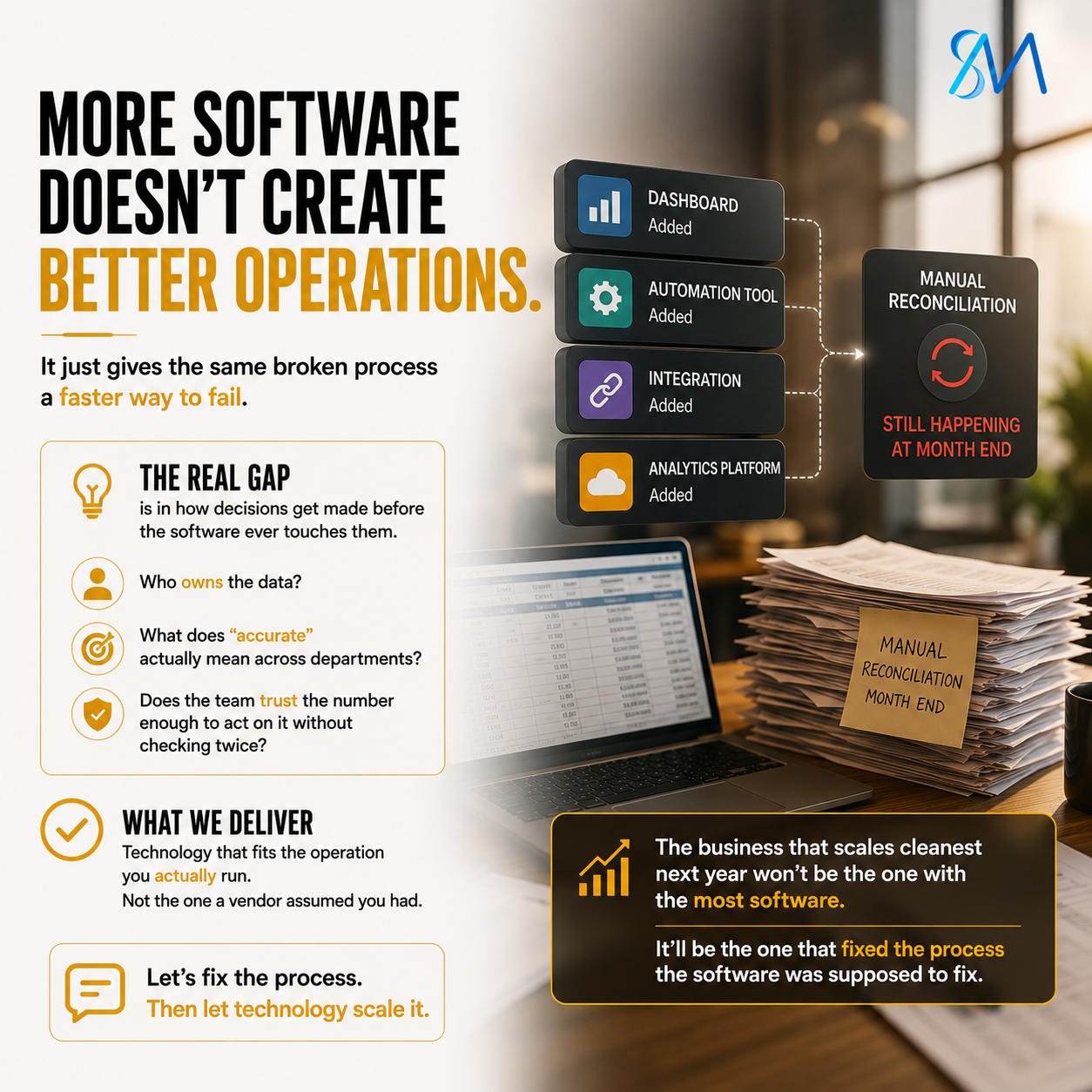
Every enterprise technology roadmap eventually arrives at the same quiet moment. A new dashboard has gone live. A new automation tool sits in the stack next to three others that promised the same thing. And at month end, the same finance team is still pulling numbers into a spreadsheet by hand, because the tool was never actually trusted to close the gap it was bought to close. Across our engagements in operational process redesign for enterprise technology, this is the single most common starting point for a serious conversation with leadership.
The cost of this pattern rarely shows up as a single number on a budget line. It shows up as a slow accumulation. A platform license renewed because cancelling it feels riskier than keeping it. A team that has quietly built its own workaround around a tool that was supposed to remove workarounds entirely. A CTO who can list every system in the stack but cannot say with confidence which one actually owns the decision that matters most this quarter. By the time this pattern is visible enough to name in a leadership meeting, it has usually been compounding for several budget cycles.
This is not a story about wasted spend, although the spend is real. It is a story about what happens when technology investment is treated as the fix for a process that was never actually defined well enough to fix. In our engineering reviews, we have found that the organisations that break this cycle do not start with a new tool. They start by naming, precisely, what the current process actually is, who owns each step of it, and where trust in the data breaks down before any system touches it.
Why the Same Gap Survives Every New Platform
The persistence of this problem is rarely a failure of ambition or budget. Across our 500+ successful projects, we consistently observe that the organisations struggling with this are often the ones who have invested the most, not the least, in technology. The gap survives because a new platform is layered onto an old decision structure, and the decision structure was never the thing being replaced.
Consider how ownership typically gets assigned inside a growing enterprise. A finance function defines what “accurate” means for its own reporting cycle. A revenue operations function defines it slightly differently, often without realising the two definitions have diverged. Neither team is wrong within its own frame. But when a new business intelligence tool is deployed to unify their reporting, it inherits both definitions at once, and produces a dashboard that both teams quietly distrust for different reasons. The software did exactly what it was built to do. It surfaced a disagreement that had existed long before the software arrived.
The organisations that scale cleanest are not the ones running the most software. They are the ones who fixed how a decision gets made before they asked a platform to make it faster.
This is why exception handling becomes permanent in so many operations. A team builds a manual check around a system output they do not fully trust. That manual check works, so it is never revisited. Two years later, three people are running that same manual check independently, and none of them remember why it started. The technology is not broken. The decision about who owns the definition of “correct” was never made in the first place.
How SuperBotics Approaches This Problem
Every SuperBotics enterprise AI and data engagement begins with a discovery and data readiness assessment before any platform conversation takes place. This is a deliberate sequencing decision, not a formality. We map how decisions currently get made, who owns each definition of accuracy across departments, and where the trust gap between teams actually sits, before recommending a single line of architecture.
Our engineering teams then apply a structured value mapping process that separates two categories of problems that are frequently treated as one. The first is a genuine capability gap, where the business needs a system to do something it currently cannot do at all. The second is a governance gap, where the capability already exists somewhere in the stack, but no one has been given clear ownership of the decision it produces. Conflating these two categories is, in our experience, the single most expensive mistake in enterprise technology planning.
| Diagnostic Question | What It Reveals |
|---|---|
| Who owns the definition of “accurate” for this metric | Governance gap versus capability gap |
| How many manual reconciliation steps exist today | Trust deficit in current systems |
| What would change operationally if this platform did not exist | Whether the investment addresses root cause |
Once the governance layer is mapped, our AI programme follows a structured 14 week model to production timeline, with responsible AI governance embedded at every stage rather than added at the end. This is the difference between a tool that produces another dashboard and a system that a leadership team is willing to act on without a second, private version of the same number sitting in someone’s inbox.
Across our AI and data engagements, clients have achieved 4x faster insight cycles and 82% automation coverage, not because the underlying models were more sophisticated than what was already available on the market, but because the governance and ownership questions were resolved before deployment, not after it. What we offer is a structured programme from strategy through production, where every stage of technical delivery is anchored to a clearly owned business decision.
The Proof Behind This Approach
One finserv client came to SuperBotics carrying exactly this pattern. Multiple reporting tools had been deployed over several years, each intended to reduce manual review. Instead, manual review time had grown, because every new tool inherited the same unresolved disagreement about what counted as a validated transaction. Our team began not with a new platform recommendation, but with a structured audit of every point where a human was overriding a system output, and why.
That audit surfaced three distinct definitions of “validated” being used across departments that all believed they were using the same one. Once ownership of a single definition was assigned and the existing systems were reconfigured around it, rather than replaced, manual review time dropped by 45%. No new platform was purchased for this outcome. The existing technology stack simply started operating under a governance structure that had never previously existed.
This result reflects a broader pattern across our AI and data engineering practice. Structured governance, defined before deployment, consistently outperforms additional tooling layered onto undefined ownership. Our clients see this play out at an average of 14 weeks from strategy to production, with the majority of that time spent on the discovery and governance phase rather than the technical build itself.
What SuperBotics Specifically Delivers
For organisations facing this exact pattern, SuperBotics delivers a structured enterprise AI and data programme that begins with an AI strategy and discovery workshop, followed by a formal data readiness and governance assessment before any platform architecture is proposed. Every engagement includes model engineering, RAG pipeline design where relevant, MLOps for sustained performance, and agentic automation, deployed across OpenAI, Google Gemini, Azure AI, Anthropic Claude, Amazon Bedrock, LangChain, and LlamaIndex depending on what the existing environment actually requires.
The governance layer we build is not a compliance checkbox. It is the operational backbone that determines whether a leadership team will act on what a system shows them without a private, manual reconciliation running in parallel. This is what allows our clients to reach 82% automation coverage and 4x faster insight cycles within a defined, measurable programme rather than an open ended technology initiative.
The Path Forward
The businesses that scale most predictably over the next several years will not be defined by the size of their technology stack. They will be defined by whether the decisions running through that stack have a single, trusted owner, and whether the systems supporting those decisions were configured around a governance structure that was actually designed, rather than one that simply accumulated.
SuperBotics has spent more than a decade building exactly this kind of structure for enterprise clients across the US, UK, France, Europe, Brazil, and Asia, anchored in a 14 week model to production benchmark and delivery data drawn from 500+ successful engagements. The technology decisions ahead do not need to be bigger. They need to be sequenced correctly, with governance built before the platform, not around it afterward.
The organisations already asking themselves which decision in their business currently depends on a private spreadsheet rather than a trusted system are the ones closest to solving this. The rest will keep adding software to a problem that software was never going to solve on its own.
Leave a Reply