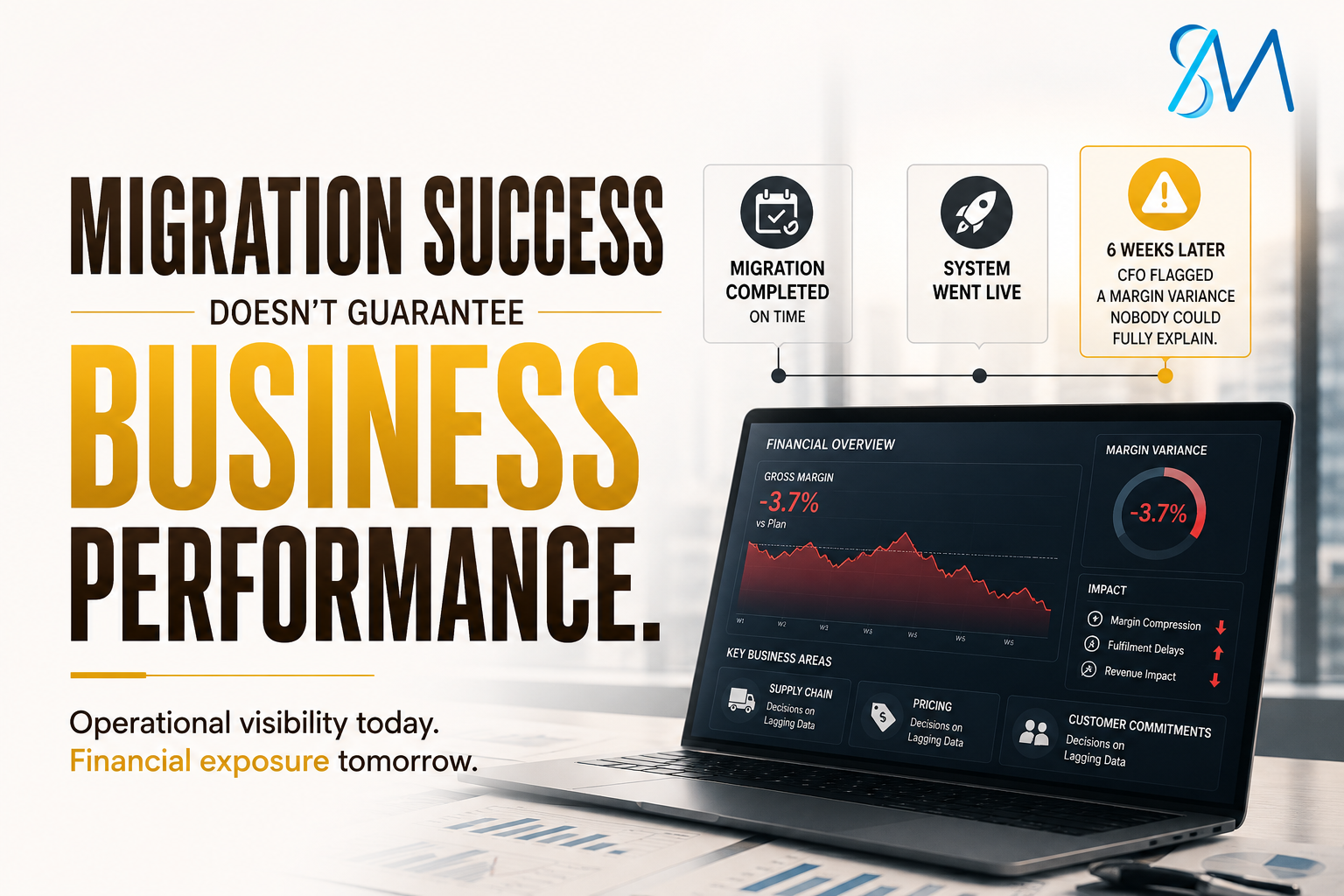
The migration completed on time. The system went live.
Six weeks later, the CFO flagged a margin variance that nobody could fully explain. Supply chain decisions had been made on lagging inventory data. A pricing review had proceeded on figures that did not yet reflect the new system’s cost allocation model. A customer escalation had been managed without the full transaction history that the new platform held but had not yet surfaced in the reporting layer.
This is the pattern that makes migration-related ROI loss difficult to track. It does not appear as a single incident. It appears as a series of decisions made on incomplete information — each one defensible in isolation, collectively producing a margin impact that the business attributes to market conditions rather than transition governance.
The teams that scaled delivery without scaling chaos did not hire faster — they changed how work was structured. The difference is visible in how their first two weeks of onboarding looked.
The Real Cost of Operational Chaos During Migration — What the Data Shows
Across our enterprise engagements, we have refined a consistent view of where migration-related ROI loss concentrates. The technical delivery is rarely the source. The governance gap between technical go-live and confirmed operational stability is where the cost accumulates.
| Operational Failure Mode | Typical Business Impact | Prevention Point |
|---|---|---|
| Decision-making on lagging data during transition | Pricing, supply chain, and margin decisions made on T-48 or T-72 hour data | Pre-go-live continuity layer design |
| Parallel system operation without defined handover criteria | Reconciliation gaps that persist for 4-8 weeks post-cutover | Stability criteria defined in operational terms before go-live |
| Escalation paths that resolve symptoms, not sources | Recurring operational incidents that each appear unique | Pattern vs. incident separation built into governance model |
| Change absorption overload on frontline teams | Informal workarounds that create invisible structural gaps | Change capacity assessment before cutover window |
The organisations that avoid these failure modes do not have less complex migrations. They have better-designed governance frameworks around them.
How Operational ROI Loss Compounds — and Why It Is Difficult to Attribute
The compounding effect of migration-related operational disruption is what makes the true ROI cost difficult to isolate. A single delayed decision does not produce a measurable outcome. A sequence of decisions made on incomplete data, across a six-to-twelve-week transition window, produces a series of small adverse outcomes that aggregate into a material business impact by the time a quarterly review surfaces them.
Migration ROI loss rarely appears as a single incident. It accumulates across dozens of decisions made on lagging data during a transition window that lasted longer than the project plan acknowledged.
In our finserv engagements, we have observed that the decisions most vulnerable to transition-related data lag are the ones with the shortest natural review cycle — daily operational calls, weekly pricing reviews, supply chain adjustments. These are precisely the decisions where a 48-hour data lag has the highest per-decision impact. And they are the decisions that happen most frequently during a transition window.
The result is not catastrophic failure. It is a steady reduction in decision quality, across the decisions that matter most to operational performance, during the period when the business is most exposed. By the time the pattern is identified, the transition has been declared complete and the data needed to connect the outcome to the cause is no longer being tracked.
The SuperBotics Approach to Migration ROI Protection
SuperBotics builds the governance infrastructure that closes the gap between technical go-live and confirmed operational stability. Our engagement model for enterprise migrations includes three elements that most transition plans do not address.
First, a decision data map — a structured inventory of every business decision that depends on system data, ranked by time-sensitivity and data lag tolerance. This is the foundation of the continuity layer design. It allows us to identify exactly which decisions need a guaranteed data source throughout the transition window, and to build that source before the cutover opens.
Second, an independent reporting layer that functions regardless of the new system’s stability status. This is not a backup system. It is a designed continuity capability that gives leadership a confirmed data source for time-sensitive decisions during the transition period. For our manufacturing and retail clients, this has consistently been the single highest-value governance investment in the migration programme.
Third, operational stability reviews at 30, 60, and 90 days post-go-live — structured around the business outcomes that matter, not the technical metrics that confirm deployment. These reviews are designed to surface the compounding effects of transition-related data gaps before they aggregate into a material business impact.
What SuperBotics Delivers — Specific, Measurable, Governed
Across 500+ successful projects and 150+ enterprise launches, our 98% on-time release rate reflects technical delivery discipline. The 6.8-year average client tenure reflects something different: the operational outcomes that follow the technical delivery, and the business confidence that those outcomes build.
For enterprise migrations specifically, we offer end-to-end transition governance across CRM, ERP, cloud infrastructure, and enterprise integration platforms. Our cross-functional pods are onboarded within 10 business days, and our governance framework is built alongside the technical delivery plan from the first week of engagement — not retrofitted after the first incident.
The Migration That Protects ROI Is Designed Before the First Configuration Change
The organisations that achieve the strongest migration ROI are not the ones with the cleanest technical delivery. They are the ones that treated operational continuity as a design problem — solved before the transition began — rather than an operational problem to be managed after go-live.
Every margin variance, every reconciliation gap, every decision made on lagging data during a transition window has a common cause: the governance infrastructure that should have prevented it was not in place when the cutover opened.
The migrations that deliver their projected ROI are the ones where that infrastructure was built first.
Want to protect the ROI of your next enterprise migration from the start?
SuperBotics builds the operational governance layer that most transition plans omit — and delivers it before your first cutover window opens.
Talk to SuperBotics about migration ROI protection →
Ready to solve this for your organization? Visit SuperBotics MultiTech to see how our team can help.
Before the sprint plan and the contract, there is a simpler question: does this model actually fit how your team works today?
The answer is usually clear within one honest conversation about your current workflow.
Leave a Reply