What Most Migrations Actually Fail On
System migrations in enterprise environments almost always fail on the same set of decisions — and almost none of them are technical decisions. The engineering execution is typically sound. The platform chosen is typically capable. The implementation partner typically delivers the configured system on the schedule the project plan describes. What fails is the operational architecture around the migration: who owns the definition of business stability during the transition, how continuity is validated before activation, what the rollback threshold is and who has the authority to invoke it, and whether the leadership team has defined what staying in control actually means before the first sprint begins. These are leadership decisions, not engineering decisions. And in the migrations SuperBotics has observed go wrong — across 14 countries, in organizations ranging from mid-market to enterprise scale — the common element is not a technology failure. It is a leadership design failure: the absence of a clear operational governance model built before the migration started and maintained through every phase of the transition. The seven rules below are drawn from 150 plus enterprise launches and a 98 percent on-time delivery record. They are not theory. They are the governance decisions that separate migrations that protect the business from migrations that disrupt it.
The stakes are high enough to warrant this level of deliberation. A system migration for an enterprise with significant operational complexity is a live business event with real-time revenue consequences. Every hour of unplanned disruption during a migration carries a cost that the project budget did not include. Every data inconsistency that surfaces post-go-live creates operational overhead that pulls the team away from the growth work the migration was supposed to enable. Every customer commitment that cannot be honored during a transition period carries a relationship cost that outlasts the technical issue that caused it. SuperBotics has consistently found that the organizations that execute migrations without material operational disruption are the ones where leadership treated the migration as an operational governance challenge first and a technology project second. The seven rules below encode what that governance looks like in practice.
The Seven Rules
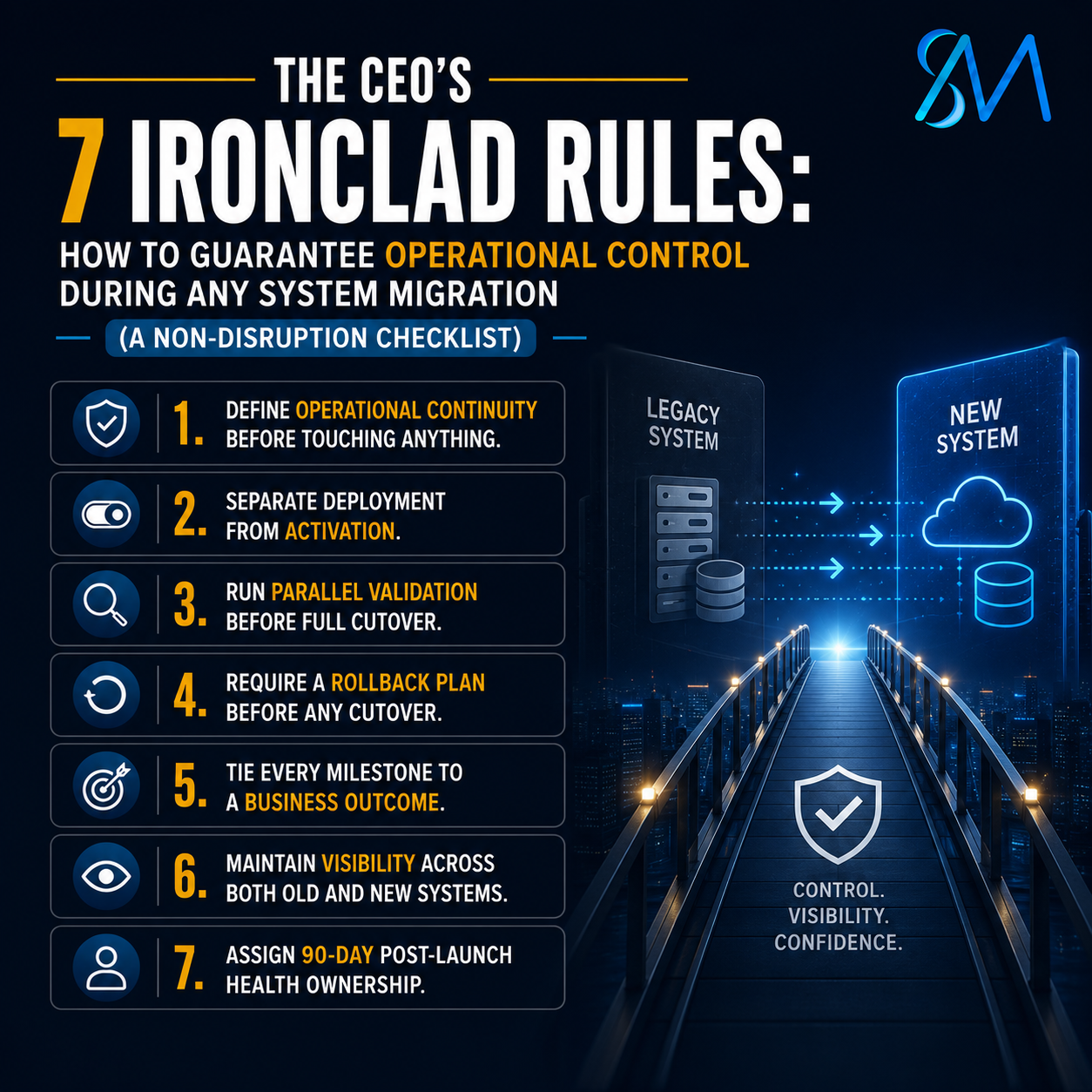
Rule One: Define operational continuity before touching anything. Before the first sprint begins, define in writing what must remain stable throughout the migration, for how long, at what performance thresholds, and who owns each continuity commitment. This definition becomes the standard against which every go-live decision is evaluated. Without it, every decision made during the migration is made against a subjective standard that different stakeholders will define differently under pressure. With it, the conversation at every milestone is factual: does the current state meet the defined continuity standard, or does it not? SuperBotics requires this definition as a prerequisite for any migration engagement because the absence of it is the single most common cause of post-go-live operational disruption.
Cloud cost and reliability problems share the same root cause in almost every organisation we work with: architecture decisions that made sense at launch and were never revisited at scale.
We have mapped the 5 patterns that cause it most often — useful to review regardless of where you are in your infrastructure journey.
Rule Two: Separate deployment from activation. Code going live in a production environment and workflows switching on are two distinct events that should be governed by two distinct decision processes. Feature flags exist precisely to enable this separation — the new system can be deployed, validated, and confirmed as stable before any operational workflow is transitioned to it. Organizations that treat deployment and activation as a single event are compressing two separate risk surfaces into one. When something goes wrong, the problem is harder to isolate and the rollback is more complex. Keeping them separate preserves optionality and control at the most consequential moment of the migration.
Rule Three: Run parallel validation before full cutover. Enterprise data is too complex and too consequential to trust a direct switch from old system to new without a period of side-by-side operation. Parallel validation — running both systems simultaneously and comparing outputs — surfaces the discrepancies that testing environments consistently miss, because production data has complexity and edge-case behavior that no testing environment fully replicates. SuperBotics requires a defined parallel validation window for every enterprise migration because the cost of a week of parallel operation is always lower than the cost of discovering a data integrity issue after the old system has been decommissioned.
Rule Four: Require a rollback plan before any cutover. A rollback plan that exists as a document but has never been tested is not a plan. It is an assumption. SuperBotics builds and tests rollback procedures for every migration before any production cutover begins, with a clear threshold: if rollback cannot be executed cleanly within 30 minutes, the deployment is carrying unnecessary risk and the threshold needs to be addressed before the cutover window opens. The organizations that invoke rollback least are the ones that have prepared for it most thoroughly.
Rule Five: Tie every milestone to a business outcome. In SuperBotics engagements, a milestone is complete when operations confirms it — not when engineering confirms it. The distinction matters because technical completion and operational readiness are different states. A system can be technically live while the operation is still unstabilized. Leadership must own the definition of operational readiness and must validate each milestone against it before the migration advances. This rule is what keeps the migration on the operational timeline rather than the engineering timeline.
Rule Six: Maintain visibility across both old and new systems during transition. The period when an organization is transitioning from one operational system to another is the period of maximum information risk. Revenue can leak through the gap between systems. Data can be committed in one environment and not reflected in the other. Operational commitments can be made against system state that has already been superseded. SuperBotics instruments both systems during every migration transition so that leadership has real-time visibility into both environments simultaneously — not a technical monitoring view, but an operational view showing order flow, SLA compliance, and processing throughput at the business layer.
Rule Seven: Assign 90-day post-launch health ownership with a named person. Most migration failures do not surface on go-live day. They surface in the weeks following go-live, as the operation encounters scenarios and edge cases that the pre-launch testing did not cover. The organizations that emerge from migrations in the strongest operational position are the ones that treat the 90 days following launch with the same governance intensity as the migration itself — with a named owner, a defined review cadence, and a clear escalation path for issues that require architectural resolution rather than operational workaround. This is the rule most teams skip. It is consistently the one that matters most.
What SuperBotics Delivers
SuperBotics delivers enterprise system migrations with operational continuity built into every phase of the architecture. The seven rules above are not advisory — they are embedded in the SuperBotics delivery methodology across every engagement. Cross-functional pods are onboarded within ten business days, delivering against defined continuity standards from sprint one. Business continuity checkpoints are established before any cutover begins. Parallel validation is required before full activation. Rollback procedures are tested, not documented. Post-launch governance runs for a defined period with named ownership and weekly health reporting. This delivery discipline is what produces the 98 percent on-time rate and the 6.8-year average client tenure that characterizes the SuperBotics partnership model. Leaders preparing for a system migration who want to understand how these seven rules would apply to their specific environment can explore more at superbotics.com.
The infrastructure decisions made in the next quarter tend to hold for longer than expected — the cost and risk profile sets early.
If you want a clear picture of where your current architecture stands, a focused review is the most useful starting point.
Leave a Reply